
Francisco Aguirre is a labor organizer and asylum seeker from El Salvador who has lived and worked in Portland, Oregon for nearly thirty years. His asylum case has been pending for years and complicated by the tortuous, drawn-out legal processes that millions of immigrants face.
Francisco was ordered to appear on July 16th, 2026 at the U.S. Immigration and Customs Enforcement (ICE) facility in Portland, Oregon for a mandatory check-in related to his continuing immigration case. These check-ins, presented as routine administrative processes, are often used as arrest traps. For example, Dolores Bustamante, a 54-year-old undocumented apple farmworker and longtime labor organizer in upstate New York, was detained when she reported for a mandatory ICE check-in in Buffalo in April 2026 and was immediately transferred to a detention facility in Louisiana, more than 1,300 miles from her family. Fortunately a court eventually ordered her release, but only after weeks of detention and a legal battle her family was forced to wage while she sat imprisoned far from home.
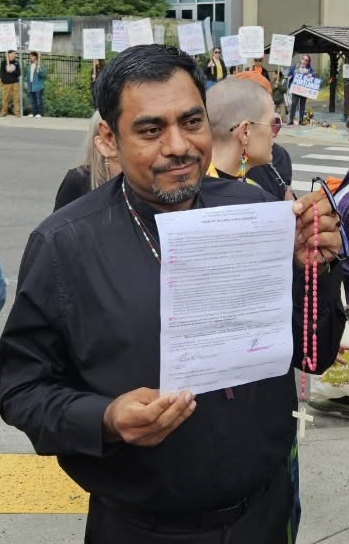
As part of the Class Struggle Action Network’s (CSAN) continuing immigrant worker solidarity and defense, including joint efforts with the Labor Committee to Defend Immigrants and passing immigrant solidarity/defense resolutions in unions to spur defensive organizing, the network mobilized its membership to show up alongside Francisco at this check-in, as did hundreds of others. This created the solidarity needed to ensure Francisco was not alone as he faced immigration authorities. Fortunately he was not detained, and paperwork was signed arranging for future check-ins, with the next one coming up in January. But the relief of that outcome cannot obscure the danger that remains: every check-in is a potential arrest, and Francisco remains in a precarious position, one shared by millions of immigrant workers across the country.
Francisco’s check-in with immigration authorities comes alongside continued violent enforcement of the state against immigrant workers. On July 7, 2026, Lorenzo Salgado Araujo, who was born in Mexico and had lived and worked in Houston for 35 years, was shot and killed by ICE agents while driving to a construction job with his coworkers in Texas. On July 13, 2026, agents fatally shot Johan Sebastián Durán Guerrero, a young Colombian father, during an enforcement operation in Biddeford, Maine. These are not isolated incidents. They are the visible edge of a state system of enforcement that kills, detains, and deports on a massive scale.
Since January 2025, at least 55 people have died in ICE custody, with the mortality rate at its highest level in over a decade. As of June 2026, ICE and CBP were making roughly 1,400 arrests per day, with the state pushing for 2,000. The scale of this enforcement is staggering: through the first six months of fiscal year 2026, ICE carried out 234,236 removals, roughly 74% more than at the same point in either of the two prior years. This represents a dramatic intensification of attacks on immigrants beyond the already brutal baseline that has existed for decades.
Through immigration and immigration-enforcement systems like U.S. Citizenship and Immigration Services (USCIS), ICE, and U.S. Customs and Border Protection (CBP), the ruling class enforce their exploitation and meet part of their labor needs to generate profit. The immigration system and its enforcement create a layer of workers who can be exploited at a higher rate due to their precarity and the fear and blackmail of arrest/deportation generated by enforcement.
As the economic crisis of capitalism continually deepens, the ruling class unleashes its historic pattern of aggressively deporting and attacking immigrants when there is less opportunity to utilize their labor for profit than in periods of economic boom. And then blaming immigrants for the social and economic woes of native workers. This pattern is not new, nor is it unique to the United States. During the Great Depression, the United States deported and forced out between one and two million Mexican workers and their U.S.-born children, the majority of whom were American citizens, after decades of actively recruiting their labor for agriculture, railroads, and industry. When the economy contracted and unemployment rose, those same workers became scapegoats and were expelled.
The same pattern operates today: immigrant labor is welcomed when it serves the needs of capital and attacked when economic crisis makes it expendable and politically useful to the ruling class as a scapegoat to quell native workers’ frustrations. The precarity that cheapens immigrant labor when capital needs it is the same precarity that makes that labor easy to expel and blame when it does not, one enforcement apparatus serving both the maintenance of a terrorized workforce and its disposal when crisis demands. The bosses attempt to divide the working class by pitting immigrant and native-born labor against each other through racist rhetoric and scapegoating, ultimately working to push down the average wage through the creation and maintenance of a highly exploited and repressed section of the working class. If immigrant labor can be terrorized into accepting lower wages and worse conditions, the conditions of the entire class are dragged downward as well.
This is not a question of which party holds office. Both the Democrats and Republicans have built, expanded, and deployed the immigration enforcement apparatus to serve the needs of capital. The 3.1 million deportations carried out under Obama, held up as a period of democratic normality, make this plain.
Moral and humanitarian appeals about the legal rights and humanity of immigrants will not stop the attacks, the deportations, and the killings we are seeing. Calls to Congress have produced nothing. Sanctuary city declarations, whatever local cooperation they have curtailed, have not prevented ICE from operating. Civic shutdowns, falsely called general strikes, and interclass coalitions such as May Day Strong, No Kings, and Indivisible have channeled workers’ energies into symbolic actions that left ICE and CBP free to operate and continue their work of terror.
The state and the bosses recognize no morality and respect rights only insofar as those rights do not interfere with their ability to accumulate profit. Only organized working-class power, rooted in the concrete economic leverage workers hold given that their labor produces the ruling class’s profit, can materially threaten the conditions that make the attacks on immigrants possible.
The answer is unified class demands and action: equal and higher wages across nationality lines / “legal statuses” and generalized strike action capable of materially confronting deportation terror. Such class-based demands and action would unite the working class and actually thwart the attacks of the ruling class on immigrants by moving toward closing the wage gap between immigrant and native workers. A struggle for higher wages closing this wage gap, with immigrant and native workers organized and fighting together, would hit at the material basis for ICE’s attacks on immigrants, the super-profits drawn from cheap immigrant labor, and the ruling class’s attacks on the working class generally.
The working class can fight for these demands effectively through strike action, and most effectively through broad general strike action, the working class’s most powerful weapon, given that the working class’s labor is the source of profit for the ruling class and, as they say, the working class remakes the world every single day. This is the basis of our power. Such action is most effective when native and immigrant workers are united based in internationalism. The working class is an international entity and must defend itself on an international basis, rejecting all divisions imposed by the bosses, including national divisions, legal statuses, and the divide between immigrant and native-born labor.
The organization needed to carry out such action does not currently exist and is not built overnight. And the power and organization we have is not enough to fully meet the scale of the attacks immigrants and the working class face today. In the current period of the U.S. labor movement, in which collaborationism with the bosses, their state, boss-linked unions and legal structures dominate, and in which a relatively better-off section of the working class remains a stabilizing factor, waging a genuine class-based struggle is an enormous challenge.
However, we must work toward it. As the inevitable crisis of capitalism deepens and pushes the working class and its struggle forward to mass levels, collaborationism and operating within the legal apparatus set up to corral workers will become untenable and openly useless for workers as our struggle intensifies. When that moment comes, the groundwork we lay now will be what allows us to meet it.
Working toward the organization the working class needs means raising the question of immigrant solidarity in your union meeting even when you feel isolated in doing so, and moving forward an immigrant solidarity and defense resolution that serves as the basis to organize within your union for this defense and solidarity. This includes building an immigrant defense and solidarity committee, bringing together workers in your union to plan and strategize action in the defense of each other, making plans for when immigration enforcement attempts to harass us and our coworkers, supporting each other through these attacks, and uniting with other unions, regions, and sections of workers in this fight. And showing up when people like Francisco face immigration authorities, so that they are not alone.
In the regime unions controlled by boss-linked leadership, we must build opposition and fight against that leadership, who are often either apathetic to the struggle of immigrant workers and racial oppression or openly anti-immigrant. Where workers are not yet organized, we must build unions on a class unionist basis, unconstrained by tiers, organized across workplaces and sectors, and free from the divisions imposed on the working class, outside the constraints of boss-linked unions and the constricting legal apparatus of the state. And where broad working-class coordination does not yet exist, we must build it across unions, regions, industries, and borders, like connecting with CSAN and joining other workers in this fight, coordinating and organizing to move forward together.
Watch for updates on Francisco’s next check-in date on CSAN’s Facebook page or email list. CSAN will share as soon as they are confirmed. His defense is the defense of the working class. Francisco is a labor organizer and asylum seeker facing the same machinery of enforcement that killed Lorenzo Salgado Araujo and countless others, moving with the purpose of continuing the profit accumulation of the bosses off of our labor, at the expense of our lives and wellness. We need working-class power and organization to confront attacks on the working class and the terror immigrants are facing.

